Crafting zero-latency realtime web architectures
Engineering high-throughput trading terminals and sports analytics platforms with sub-50ms render latency and zero layout shifts.
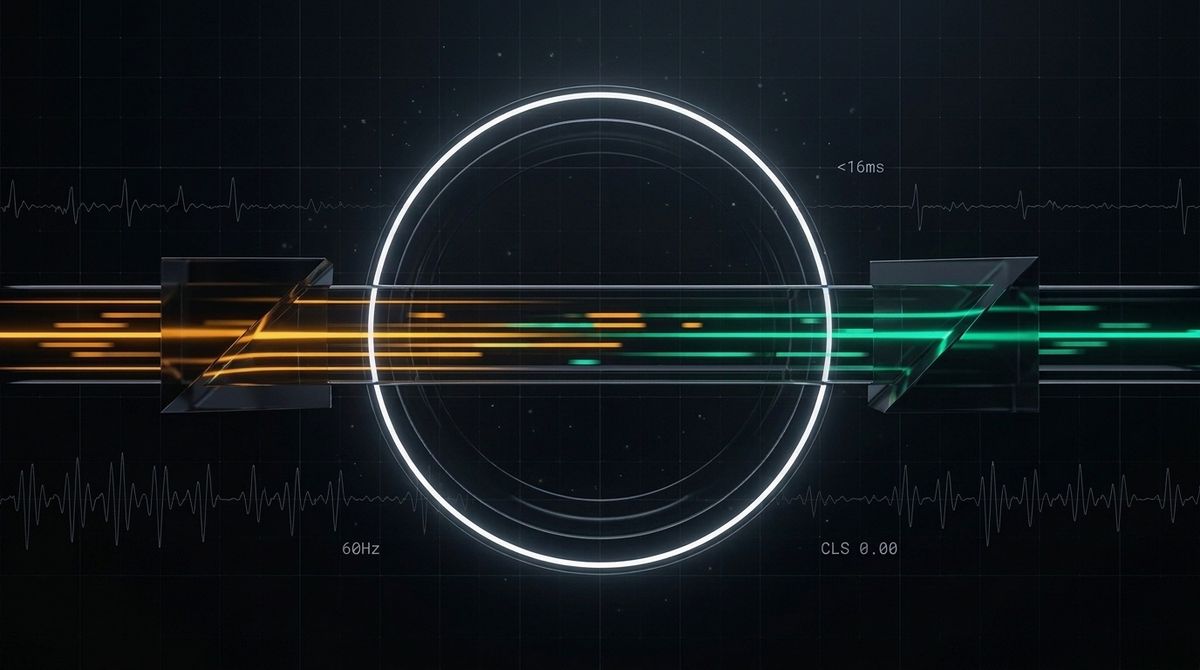
When building platforms like DerivConnect (multi-asset trading) and TipsDeck (live sports odds), standard request-response cycles fail immediately. Users expect price updates, order book movements, and probability shifts to reflect instantly with zero visual flicker and zero cumulative layout shift (CLS).
Decoupling socket ingestion from the React render tree
In financial trading terminals and live sports intelligence systems, WebSockets stream hundreds of payload packets per second. The most common novice mistake is calling setState(event.data) directly on every incoming socket message.
Dispatching 120 React reconciliations per second starves the JavaScript main thread, causing missed user clicks, delayed scroll responses, and device heating. To maintain 60 FPS, decouple the transport layer from the view layer.
Optimistic UI mutations with surgical rollback
Users expect instant tactile feedback when placing a trade, submitting a prediction, or saving a preference. Waiting 250ms for a round-trip HTTP ACK makes modern web applications feel sluggish and unresponsive.
With TanStack Query, mutate the cache synchronously inside onMutate, render the updated state immediately, and snapshot the previous cache context. If the server responds with a 4xx or 5xx status, revert the snapshot and notify the user with a subtle toast without breaking layout flow.
“Sub-50ms optimistic feedback turns web applications into extensions of the user's nervous system.”
— Sule Malik, Engineering Note
Network resilience with jittered backoff
Mobile networks fluctuate constantly when users traverse elevators, subway stations, or cellular towers. When a WebSocket drops, naive retry loops flood the edge server with thousands of simultaneous reconnect requests, creating a self-inflicted denial-of-service attack.
Implement exponential backoff augmented with randomized full jitter. When the socket reconnects, rehydrate delta state using sequence IDs rather than fetching the entire database dataset.
- ✓Never map high-frequency socket events 1:1 to React component state; use external buffers batched via RAF.
- ✓Implement optimistic mutations with automatic rollback to provide instant tactile feedback on user actions.
- ✓Pre-allocate UI dimensions with explicit container sizing to maintain a Cumulative Layout Shift (CLS) score of 0.00.
- ✓Design connection heartbeats with exponential jitter to prevent connection storms when networks recover.

Sule Malik
Product-Minded Software Engineer · Asante Mampong, Ghana
Product-minded software engineer specializing in React 19, TypeScript, React Native, and high-performance web systems. Based in Asante Mampong, Ghana.